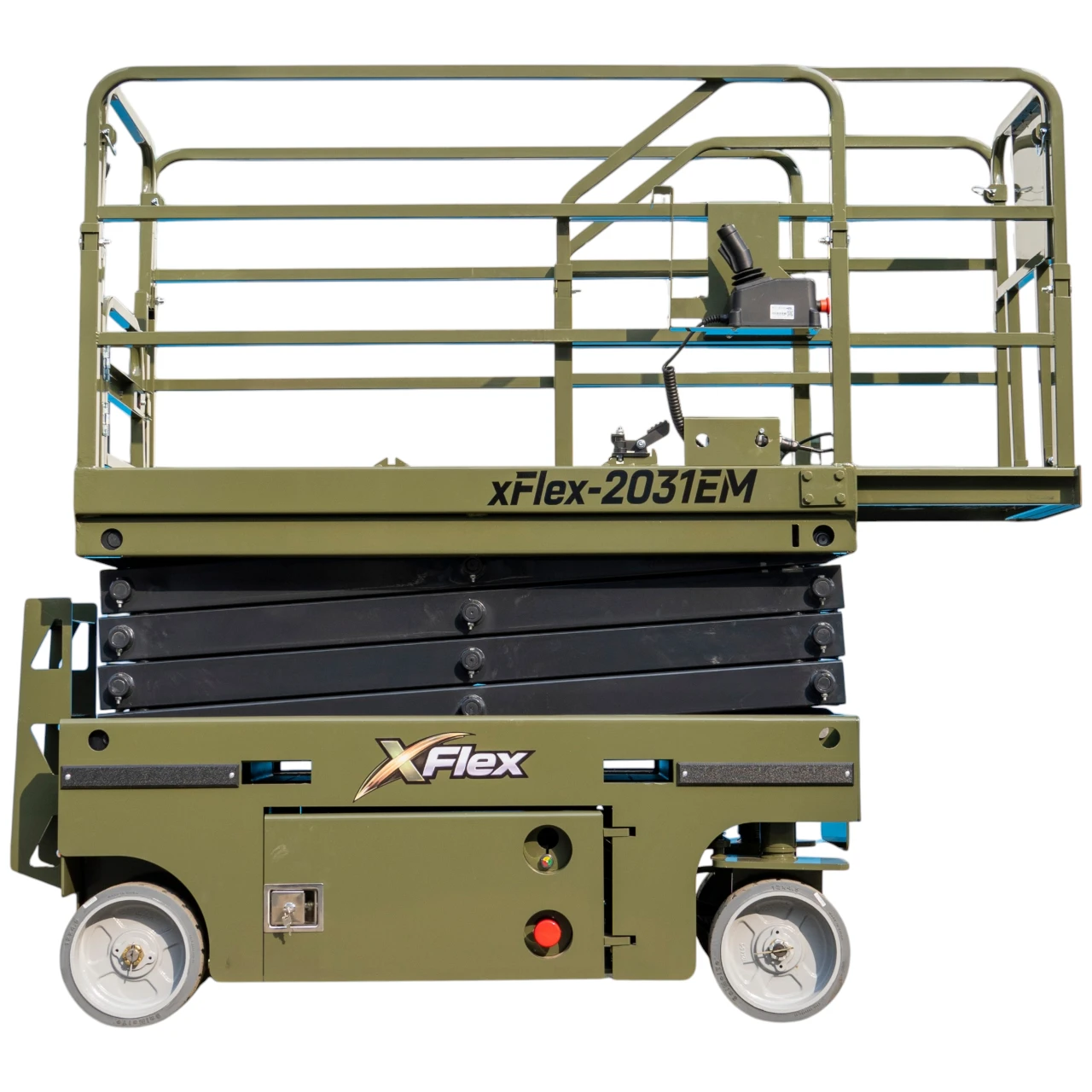
Electric and tracked scissor lifts have become the gold standard for elevated work on commercial construction, electrical fit-outs, mechanical ducting, and warehouse maintenance. Their silent operation, zero emissions, and compact turning radii make them indispensable indoors and on sensitive turf. However, nothing halts jobsite productivity faster than a scissor lift battery bank that exhausts its charge mid-afternoon, stranding tools at height or disabling drive functions on access ramps. Understanding the relationship between battery capacity (Amp-Hours / Ah), chemistry, depth of discharge (DoD), and duty cycle demands is critical for equipment reliability.
1. Deconstructing the Scissor Lift Duty Cycle
A scissor lift’s daily duty cycle involves far more than simply holding operators at an elevated height. Electric scissor lifts consume electrical energy across four distinct operating phases:
- Horizontal Travel (Drive Duty): Moving across concrete slabs, exterior asphalt, or uneven construction terrain. Electric wheel motors or hydraulic drive motors draw continuous current (30 to 80 Amps) during transit. Negotiating ramps or rough terrain spikes draw significantly higher.
- Platform Elevation (Hydraulic Pump Inrush): Raising a loaded platform to maximum working height (19 to 40+ feet) requires the electric motor to drive a high-pressure hydraulic pump. Lifting a full rated platform capacity (500 to 1,000 lbs) demands massive inrush current (150 to 250+ Amps) for the duration of the lift cycle (25 to 45 seconds).
- Control and Steering Standby: Powering ECU controllers, tilt sensors, safety interlocks, LED beacon lights, and electric steering actuators draws a steady 2 to 5 Amps continuously throughout the shift.
- Auxiliary AC Inverter Outlets: When operators connect power tools, hammer drills, or work lights directly into the platform's auxiliary 110V/220V inverter outlet, battery draw increases dramatically.
If an equipment buyer selects a battery bank sized only for light maintenance duty (e.g., 2 to 4 elevations per shift) and deploys that machine on an MEP installation job requiring 40 to 60 elevation cycles per day, the battery bank will experience severe premature voltage collapse.
2. Amp-Hour (Ah) Ratings and Peukert's Law
Battery capacity is commonly specified in Amp-Hours (Ah), typically tested at a standard 20-hour discharge rate (C/20). For example, a 225 Ah battery is rated to deliver 11.25 Amps continuously for 20 hours before reaching cutoff voltage (10.5V on a 12V battery).
However, scissor lifts do not discharge batteries at a gentle 11-Amp rate. Elevating a fully loaded scissor deck pulls 180+ Amps. According to Peukert's Law, the higher the rate of electrical discharge, the lower the actual usable capacity of a lead-acid battery:
Peukert's Law: I^k × t = H
(Where I is discharge current, k is the Peukert constant ~1.2 to 1.4 for lead-acid, t is discharge time, and H is rated capacity).
Under heavy discharge pulses, an internal chemical bottleneck occurs within the battery plates. A lead-acid battery rated at 225 Ah may effectively yield only 140 to 160 Ah of usable energy when subjected to frequent high-current elevation cycles, leading to unexpected afternoon platform lockouts.
3. Comparing Battery Chemistries: Flooded vs. AGM vs. Lithium (LiFePO4)
Matching the duty cycle requires choosing the right battery chemistry for your operational demands:
| Feature |
Flooded Deep-Cycle Lead-Acid |
AGM (Absorbed Glass Mat) |
Lithium Iron Phosphate (LiFePO4) |
| Usable Depth of Discharge (DoD) |
50% recommended (max 80%) |
60% recommended (max 80%) |
95% to 100% without damage |
| Cycle Life (to 80% Capacity) |
500 – 800 cycles |
700 – 1,000 cycles |
3,000 – 5,000+ cycles |
| Maintenance |
Requires regular distilled water additions |
Maintenance-free, sealed |
100% Maintenance-free with internal BMS |
| Voltage Curve Under Load |
Sloped; noticeable voltage drop as discharge progresses |
Moderately flat; good surge capability |
Completely flat; 100% lift speed down to 5% charge |
| Opportunity Charging |
Harmful (shortens cycle life) |
Tolerable but reduces longevity |
Excellent (fast charge during lunch breaks) |
For high-cycle commercial contractors and rental fleets, Lithium (LiFePO4) battery technology provides overwhelming return on investment. Lithium batteries maintain constant platform elevation speed throughout the entire shift, recharge fully in 2 to 3 hours (compared to 8 to 12 hours for lead-acid), and support rapid opportunity charging during breaks without memory effect or plate sulfation.
4. Cold Weather Derating Factors
Ambient temperature exerts an immediate impact on electro-chemical reaction speed within battery cells. At 77°F (25°C), batteries perform at 100% rated capacity. However, for every 1°F drop below 77°F, battery capacity decreases by approximately 0.5% to 0.7%:
- At 32°F (0°C), available lead-acid battery capacity drops to roughly 70% to 75% of nominal rating.
- At 14°F (-10°C), usable capacity plunges to 50% to 55%.
Contractors working on unheated winter builds or cold storage facilities must size their battery capacity 30% to 40% higher than summer calculations, or opt for Lithium batteries equipped with internal thermal heating blankets.
5. Best Practices to Maximize Battery Lifespan and Machine Uptime
- Avoid Deep Discharges Below 20%: Modern scissor lift controllers activate a "turtle mode" or lock out elevation when battery charge reaches 20% to prevent cell reversal and motor damage. Never bypass these safety interlocks.
- Conduct Regular Equalization Charges: For flooded lead-acid batteries, perform an equalization charge every 30 days to re-balance cell specific gravities and reverse plate sulfation.
- Maintain Clean Terminal Connections: Corroded terminals introduce electrical resistance that drops voltage at the hydraulic pump motor, tripping false low-voltage error codes.
- Use Temperature-Compensated Smart Chargers: Ensure chargers adjust float and absorption voltages based on ambient temperatures to avoid undercharging in winter and boil-off in summer.
Discover professional, zero-emission elevated work platforms at KONSTRUCTZ, featuring robust battery systems, rough-terrain rubber tracks, and full U.S. warranty support backed by our 4.9/5 star contractor rating.