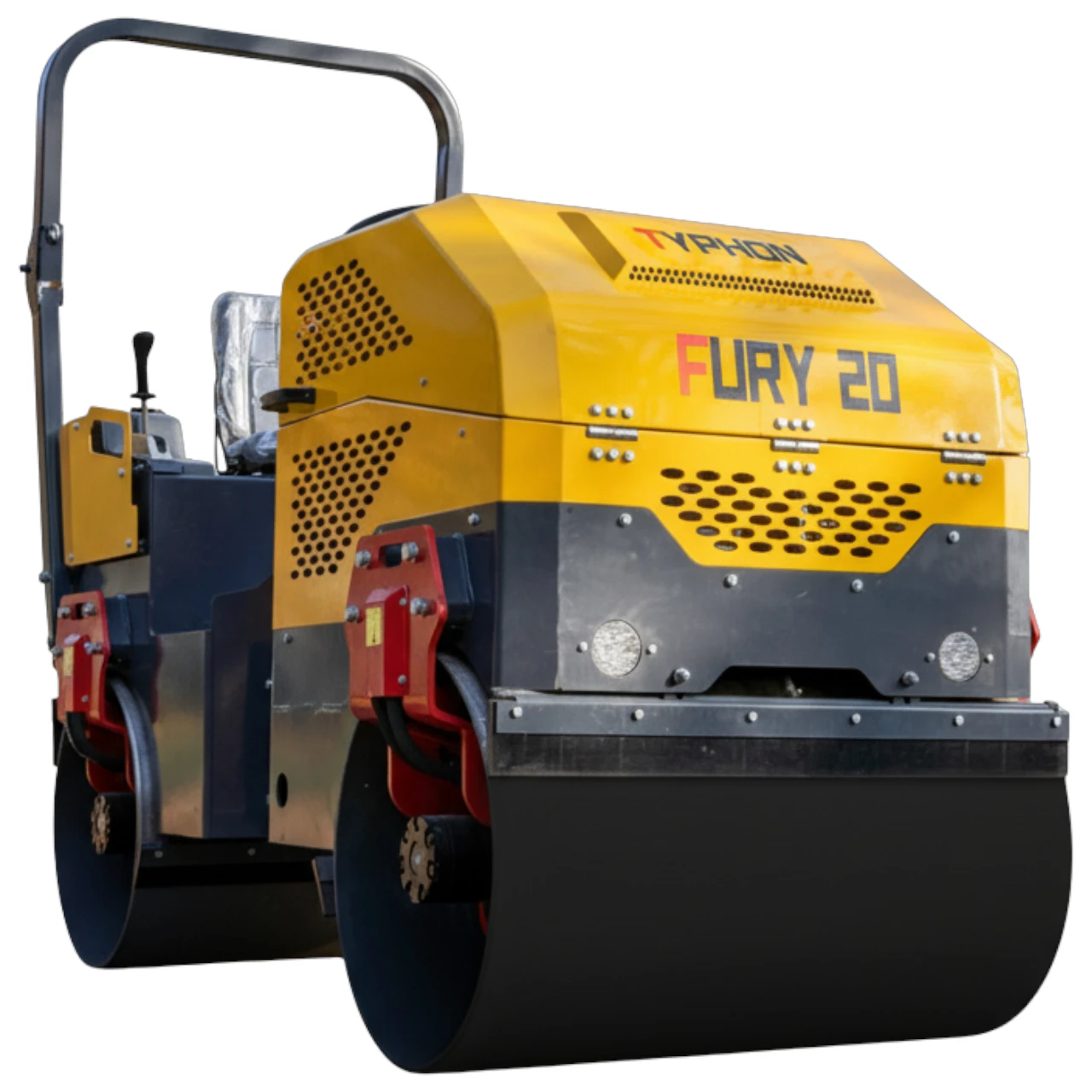
Compacting asphalt mats, sub-base gravels, and engineered soil fills requires rigorous adherence to civil engineering specifications. While operators often focus heavily on drum diameter, static linear load, and vibratory frequency, one critical operational variable governs whether a compaction pass succeeds or fails: maintaining a consistent, steady travel speed under full vibratory load. If a road roller’s engine lacks sufficient horsepower and torque reserve, the machine will bog down on grades or deep lifts, causing travel speed fluctuations that lead to washboarding, irregular density pockets, and costly re-work.
1. The Physics of Dynamic Vibratory Compaction
A vibratory road roller compacts material through a combination of two forces:
- Static Force: The downward gravitational weight of the roller drum and frame resting on the surface.
- Dynamic Centrifugal Force: Generated by high-speed rotating eccentric shafts housed inside the drum, spinning at frequencies between 2,500 and 4,000 vibrations per minute (VPM).
As the eccentric weight rotates, it delivers rapid vertical impact pulses into the soil or asphalt mat. These pulses overcome aggregate friction, causing granular particles to rearrange, eliminate air voids, and interlock into a dense, solid matrix.
2. The Critical Rule of Impact Spacing (10 to 14 Impacts per Foot)
For high-quality asphalt paving and structural base compaction, highway authorities and asphalt paving associations (such as NAPA and state DOTs) mandate a strict impact spacing standard:
Impact Spacing (Impacts per Linear Foot) = Vibratory Frequency (VPM) ÷ [Travel Speed (MPH) × 88]
To achieve uniform density and prevent harmonic ripples, the roller drum must deliver between 10 and 14 impact pulses per linear foot:
- If Travel Speed is Too Fast: Impacts spread out beyond 14 inches apart. The drum "skips" across the surface, leaving uncompacted gaps between impact zones and creating an undulating, bumpy ride quality.
- If Travel Speed is Too Slow: Impacts pack too tightly (more than 16 impacts per foot). The drum repeatedly strikes an already-compacted mat, causing aggregate fracturing, degradation of asphalt binder, and surface checking.
- If Travel Speed is Consistent (2.5 to 3.5 MPH @ 3,000 VPM): Impacts overlap perfectly, achieving 95% to 98% target density across the entire pass.
3. Engine Power Allocation: Propulsion vs. Vibratory Exciter Motors
A road roller’s diesel engine must simultaneously drive two demanding hydraulic circuits through a dual hydrostatic pump system:
- Propulsion Hydrostatic Circuit: Powers high-torque hydraulic wheel and drum drive motors to push or pull a multi-ton steel drum across uncompacted, loose material that creates immense rolling resistance.
- Vibratory Exciter Circuit: Drives hydraulic motors spinning heavy eccentric weights at thousands of RPM. Overcoming the initial inertia of the eccentric shafts requires substantial starting torque, and maintaining that momentum demands 40% to 55% of continuous engine output.
When an underpowered roller begins climbing an incline (such as a crowned roadway, bridge approach ramp, or driveway slope) with vibration engaged, total horsepower demand surges. If the engine lacks adequate torque reserve, engine RPM droops. This droop reduces hydraulic pump output, causing the roller to either slow down unexpectedly or drop vibratory frequency—destroying impact spacing consistency.
4. Asphalt Breakdown Rolling: The Critical Temperature Window
On asphalt paving jobs, time is temperature. Hot Mix Asphalt (HMA) arrives on site at approximately 300°F (150°C) and is compacted behind the screed during the breakdown rolling window between 280°F and 240°F (138°C to 115°C). Once the asphalt mat cools below 175°F (80°C), the bitumen binder stiffens and further vibratory rolling will crush stone aggregates rather than increase density.
To compact the mat before it cools, the roller must maintain a relentless, predictable travel pace across designated rolling patterns. An engine that bogs down under dual-drum vibration forces the operator to make extra passes, allowing the asphalt to cool below its compaction threshold and resulting in failed nuclear density gauge tests.
5. Soil Compaction and Proctor Density Requirements
For civil earthworks, utility trench backfill, and foundation pads, specifications typically call for 95% or 98% Standard or Modified Proctor Density (ASTM D698 / D1557). Cohesionless soils (gravel, crushed rock, decomposed granite) respond best to high-frequency vibratory energy, while cohesive soils (clay, silty clay) require high-amplitude kneading force.
Adequate engine horsepower allows the roller to maintain steady travel velocity even when plowing through deep 8-inch to 12-inch uncompacted soil lifts, ensuring that the pressure bulb reaches the full depth of the lift and ties into the underlying layer without leaving soft sub-grade pockets.
6. Key Equipment Features to Look For in a Road Roller
- Adequate Power-to-Weight Ratio: Ensure the engine provides at least 25 to 35 HP per ton of operating weight on compact vibratory rollers.
- Dual Vibration Frequencies and Amplitudes: Allows tailoring centrifugal force to thin asphalt surface courses versus thick granular base lifts.
- Hydrostatic Drum and Wheel Drive: Dual drum drive eliminates pushing or shoving of hot asphalt in front of the drum during direction reversals.
- Pressurized Water Sprinkler System: High-capacity water tanks with intermittent timers to prevent asphalt pickup on hot drums.
Explore durable, high-efficiency road rollers and vibratory compactors at KONSTRUCTZ, backed by direct nationwide shipping, complete OEM parts support, and a trusted 4.9/5 star contractor satisfaction rating.